
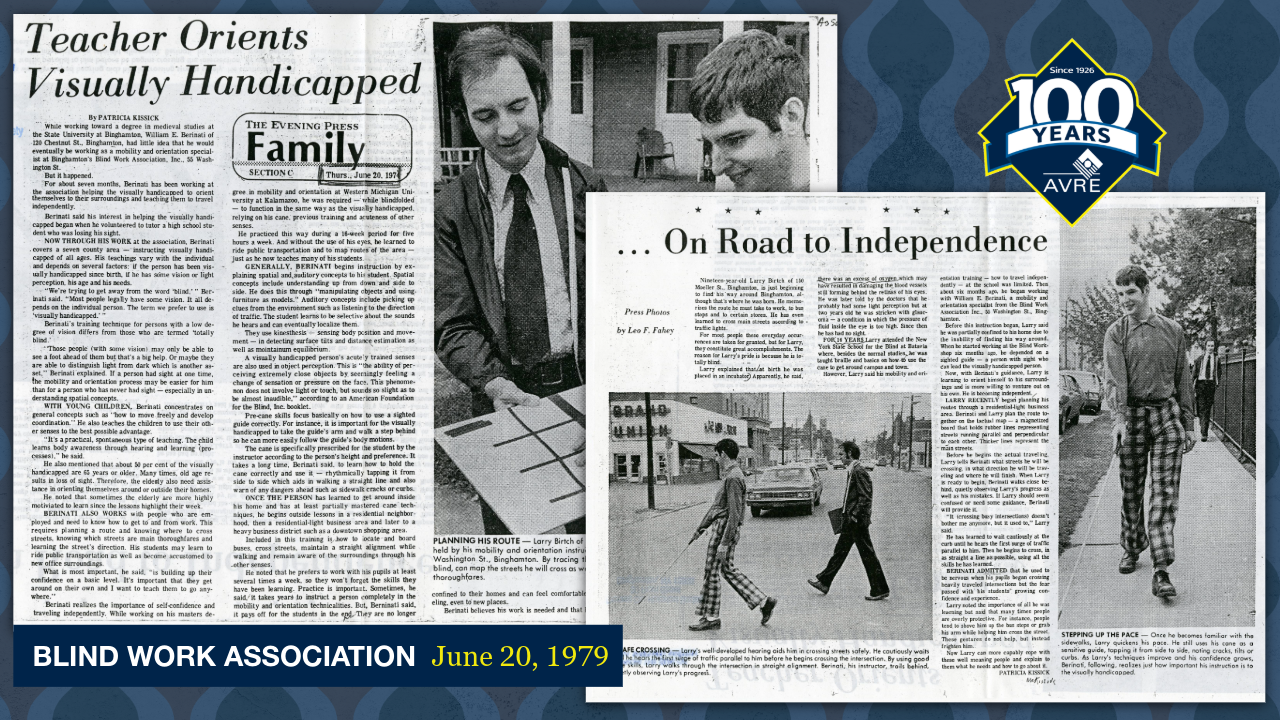
Teacher Orients Visually Handicapped
By PATRICIA KISSACK
While working toward a degree in medieval studies at the State University at Binghamton, William E. Berinati of 120 Chestnut St., Binghamton, had little idea that he would eventually be working as a mobility and orientation specialist at Binghamton’s Blind Work Association, Inc., 55 Washington St.
But it happened.
For about seven months, Berinati has been working at the association helping the visually handicapped to orient themselves to their surroundings and teaching them to travel independently.
Berinati said his interest in helping the visually handicapped began when he volunteered to tutor a high school student who was losing his sight.
NOW THROUGH HIS WORK at the association, Berinati covers a seven county area — instructing visually handicapped of all ages. His teachings vary with the individual and depends on several factors: if the person has been visually handicapped since birth; if he has some vision or light perception; his age and his needs.
“We’re trying to get away from the word ‘blind,’” Berinati said. “Most people legally have some vision. It all depends on a individual person. The term we prefer to use is visually handicapped.”
Berinati’s training technique for persons with a low degree of vision differs from those who are termed “totally blind.”
“These people (with some vision) may only be able to see a foot ahead of them but that’s a big help. Or maybe they are able to distinguish light from dark which is another asset,” Berinati explained. If a person had sight at one time, the mobility and orientation process may be easier for him than for a person who has never had sight — especially in understanding spatial concepts.
WITH YOUNG CHILDREN, Berinati concentrates on general concepts such as “how to move freely and develop coordination.” He also teaches the children to use their other senses to the best possible advantage.
“It’s a practical, spontaneous type of teaching. The child learns body awareness through hearing and learning (processes),” he said.
He also mentioned that about 50 per cent of the visually handicapped are 65 years or older. Many times, old age results in loss of sight. Therefore, the elderly also need assistance in orienting themselves around or outside their homes.
He noted that sometimes the elderly are more highly motivated to learn since the lessons highlight their weakness.
BERINATI ALSO WORKS with people who are employed and need to know how to get to and from work. This requires planning a route and knowing where to cross streets, knowing which streets are main thoroughfares and learning the street’s direction. His students may learn to ride public transportation as well as become accustomed to new office surroundings.
What is most important, he said, “is building up their confidence on a basic level. It’s important that they get around on their own and I want to teach them to go anywhere.”
Berinati realizes the importance of self-confidence and traveling independently. While working on his masters degree in mobility and orientation at Western Michigan University at Kalamazoo, he was required — while blindfolded — to function in the same way as the visually handicapped, relying on his cane, previous training and acuteness of other senses.
He practiced this way during a 16-week period for five hours a week. And without the use of his eyes, he learned to ride public transportation and to map routes of the area — just as he now teaches many of his students.
GENERALLY, BERINATI begins instruction by explaining spatial and auditory concepts to his student. Spatial concepts include understanding up from down and side to side. He does this through “manipulating objects and using furniture as models.” Auditory concepts include picking up clues from the environment such as listening to the direction of traffic. The student learns to be selective about the sounds he hears and can eventually localize them.
They use kinesthesis — sensing body position and movement — in detecting surface tilts and distance estimation as well as maintaining equilibrium.
A visually handicapped person’s acuity to trained senses are also used in object perception. This is “the ability of perceiving extremely close objects by seemingly feeling a change of sensation or pressure on the face. This phenomenon does not involve light or touch, but sounds so slight as to be almost inaudible,” according to an American Foundation for the Blind, Inc. booklet.
Pre-cane skills focus basically on how to use a sighted guide correctly. For instance, it is important for the visually handicapped to take the guide’s arm and walk a step behind so he can more easily follow the guide’s body motions.
The cane is specifically prescribed for the student by the instructor according to the person’s height and preference. It takes a long time, Berinati said, to learn how to hold the cane correctly and use it — rhythmically tapping it from side to side which aids in walking a straight line and also warn of dangers ahead such as sidewalk cracks or curbs.
ONCE THE PERSON has learned to get around inside his home and has at least partially mastered cane techniques, he begins outside lessons in a residential neighborhood, then a residential-light business area and later to a heavy business district such as a downtown shopping area.
Included in this training is how to locate and board buses, cross streets, maintain a straight alignment while walking and remain aware of the surroundings through his other senses.
He noted that he prefers to work with his pupils at least several times a week, so they won’t forget the skills they have been learning. Practice is important. Sometimes, he said, it takes years to instruct a person completely in the mobility and orientation technicalities. But, Berinati said, it pays off for the students in the end. They are no longer confined to their homes and can feel comfortable in traveling, even to new places.
Berinati believes his work is needed and that he is helping the visually handicapped become more independent individuals, but he added, “Although they need concentrated training, more than ever they need to be accepted.”
Photo Caption (right side)
PLANNING HIS ROUTE — Larry Birtch of 150 Moeller St., Binghamton, makes good use of the tactual map held by his mobility and orientation instructor, William E. Berinati of the Blind Work Association, Inc., 55 Washington St., Binghamton. By tracing the rubber lines on the magnetized board, Larry, who is totally blind, can map the streets he will cross as well as know the direction he is traveling and which streets are main thoroughfares.
… On Road to Independence
Nineteen-year-old Larry Birtch of 150 Moeller St., Binghamton, is just beginning to find his way around Binghamton, although that’s where he was born. He memorizes the route he must take to work, to bus stops and to certain stores. He has even learned to cross main streets according to traffic lights.
For most people these everyday occurrences are taken for granted, but for Larry, they constitute great accomplishments. The reason for Larry’s pride is because he is totally blind.
Larry explained that at birth he was placed in an incubator. Apparently, he said, there was an excess of oxygen which may have resulted in damaging the blood vessels still forming behind the retinas of his eyes. He was later told by the doctors that he probably had some light perception but at two years old he was stricken with glaucoma — a condition in which the pressure of fluid inside the eye is too high. Since then he has had no sight.
For 14 YEARS Larry attended the New York State School for the Blind at Batavia where, besides the normal studies, he was taught braille and basics on how to use the cane to get around campus and town.
However, Larry said his mobility and orientation training — how to travel independently — at the school was limited. Then about six months ago, he began working with William E. Berinati, a mobility and orientation specialist from the Blind Work Association Inc., 55 Washington St., Binghamton.
Before this instruction began, Larry said he was partially confined to his home due to the inability of finding his way around. When he started working at the Blind Workshop six months ago, he depended on a sighted guide — a person with sight who can lead the visually handicapped person.
Now, with Berinati’s guidance, Larry is learning to orient himself to his surroundings and is more willing to venture out on his own. He is becoming independent.
LARRY RECENTLY began planning his routes through a residential-light business area. Berinati and Larry plan the route together on the tactual map — a magnetized board that holds rubber lines representing streets running parallel and perpendicular to each other. Thicker lines represent the main streets.
Before he begins the actual traveling, Larry tells Berinati what streets he will be crossing, in what direction he will be traveling and where he will finish. When Larry is ready to begin, Berinati walks close behind, quietly observing Larry’s progress as well as his mistakes. If Larry should seem confused or need some guidance, Berinati will provide it.
“It (crossing busy intersections) doesn’t bother me anymore, but it used to,” Larry said.
He has learned to wait cautiously at the curb until he hears the first surge of traffic parallel to him. Then he begins to cross, in as straight a line as possible, using all the skills he has learned.
BERINATI ADMITTED that he used to be nervous when his pupils began crossing heavily traveled intersections but the fear passed with his students’ growing confidence and experience.
Larry noted the importance of all he was learning but said that many times people are overly protective. For instance, people tend to shove him up the bus steps or grab his arm while helping him cross the street. These gestures do not help, but instead frighten him.
Now Larry can more capably cope with these well meaning people and explain to them what he needs and how to go about it.
PATRICIA KISSACK
Photo Caption (bottom left image)
A SAFE CROSSING — Larry’s well-developed hearing aids him in crossing streets safely. He cautiously waits until he hears the first surge of traffic parallel to him before he begins crossing the intersection. By using good cane skills, Larry walks through the intersection in straight alignment. Berinati, his instructor, trails behind, quietly observing Larry’s progress.
Photo Caption (right image)
STEPPING UP THE PACE — Once he becomes familiar with the sidewalks, Larry quickens his pace. He still uses his cane as a sensitive guide, tapping it from side to side, noting cracks, tilts or curbs. As Larry’s techniques improve and his confidence grows, Berinati, following, realizes just how important his instruction is to the visually handicapped.